Garnet boasts a rich and ancient history, with some of the earliest evidence dating back to around 3100 BCE. Red garnet necklaces, for instance, have been discovered in the tombs of ancient Egyptian pharaohs, prized as symbols of life and protection in the afterlife.
Unlike beryl and corundum (which include single species such as emerald, aquamarine, sapphire, and ruby), garnet is not a single gemstone species. Instead, it refers to a group of silicate minerals that share a similar crystal structure and general chemical formula. Common species within the garnet family include almandine, grossular (often referred to as grossularite), spessartine (or spessartite), pyrope, andradite, and uvarovite. There are more than 20 recognised garnet species in total, and many of these have additional varieties. This diversity is the reason garnets can be found in a wide range of colours—virtually every hue except pure blue.
Red garnets are by far the most abundant and are found worldwide, but only a small fraction possess the quality required for use in jewellery. At the opposite end of the rarity spectrum is blue garnet. Colour-changing garnets that appear blue (or blue-green) in daylight were not discovered until the late 1990s, when deposits were found near Bekily in Madagascar. These rare stones are pyrope-spessartine garnets containing vanadium and shift to purple or purplish-red under incandescent light.
The word “garnet” derives from the medieval Latin “granatum,” meaning pomegranate, due to the resemblance between many red garnet crystals and the seeds (arils) of the dark red fruit.
Garnet varieties have a Mohs hardness ranging from 6.5 to 7.5, which makes them somewhat more susceptible to scratches and wear compared to harder gems like sapphire (Mohs 9) or diamond (Mohs 10).
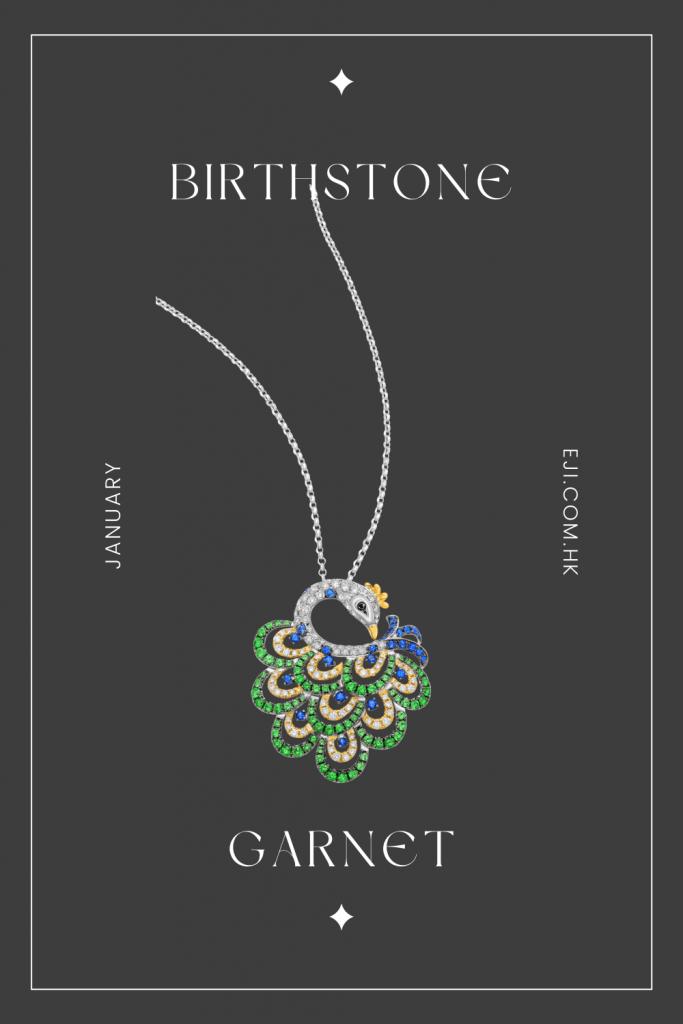
Garnet is the birthstone for those born in January and the gemstone traditionally associated with the second wedding anniversary. Red garnet jewellery is particularly suitable for celebrating a budding relationship, evoking passion and fiery intensity.
As mentioned earlier, the garnet group consists of over 20 gemstone species, with some rarer than others. Below, we cover some of the more popular and sought-after members of the garnet family.
Almandine is one of the oldest known garnets, named after “Alabanda” (modern-day Alabanda in Turkey), where it was historically cut, as noted by Pliny the Elder. It displays a colour range from reddish-brown to violet-red due to iron in its composition. Almandine can be found worldwide, but only a small portion is of gem quality.

Pyrope is another common garnet variety bearing a dark red hue, with its colour derived from magnesium rather than iron. Its name originates from the ancient Greek “pyropos,” meaning “fiery-eyed,” stemming from the words “pyr” (fire) and “ops” (eye). One of the most famous garnet pieces, the Antique Pyrope Hair Comb (a Victorian-era jewel featuring rose-cut pyropes from the historic Bohemian mines in what is now the Czech Republic), is made from pyrope and is part of the Smithsonian Institution’s collection.
Topazolite is the yellow to brownish-yellow variety of andradite garnet. It is controversially named for its visual resemblance to topaz (though the two are chemically unrelated). The golden hue of this rare garnet variety is attributed to the presence of ferric iron ions.
First discovered in Russia in the 19th century, demantoid is the green variety of andradite. Named after the Dutch word “demant” (meaning diamond), this green gem is rare and highly sought after. It possesses exceptional brilliance and dispersion (higher than diamonds), often displaying more “fire” than even the most renowned green gems.
Tsavorite, the vivid green variety of grossular garnet, was discovered in 1967 by British geologist Campbell R. Bridges and introduced to the market in the early 1970s. It was named after Kenya’s Tsavo East National Park by Henry Platt, then-president of Tiffany & Co. The gem is renowned for its intense, emerald-like green colour, derived from traces of vanadium and chromium.
Named after its original locality in the Spessart region of Germany, spessartine ranges from orange to reddish-brown due to manganese-aluminium trace elements. “Mandarin garnet” is a trade name for bright, pure orange spessartine, first discovered in significant quantities in Namibia in the early 1990s. These vibrant stones quickly gained fame for their exceptional colour and brilliance.